Expenses that keep rising in line with prices. By introducing the Respo reservation ledger, we reduced operational workload while keeping costs down (Cafe baton).
Located in the southwest of Aomori Prefecture, Hirosaki City flourished as the castle town of the Hirosaki Domain. The Hirosaki Civic Hall, situated on the grounds of Hirosaki Castle Ruins and Hirosaki Park, is a historic building designed by Kunio Maekawa, a master of modern architecture. It houses a large hall for concerts and performing arts, as well as multipurpose rooms, and serves as a cultural hub that attracts many people.
The only cafeteria in the building, “Kissashitsu baton,” offers visitors an extraordinary experience in a refined, Showa-modern space. It is so popular that during peak seasons the wait can be as long as two hours, but thanks to the introduction of the reservation ledger system Respo by AutoReserve (hereafter “Respo”), the operational workload has been reduced. We spoke with the owner, Hitoshi Urushidate, about what led to the implementation and the current state of management amid rising prices.
Creation date: 2024年3月6日
Update date: 2026年2月26日

Table of contents
Providing a refined space imbued with history and culture
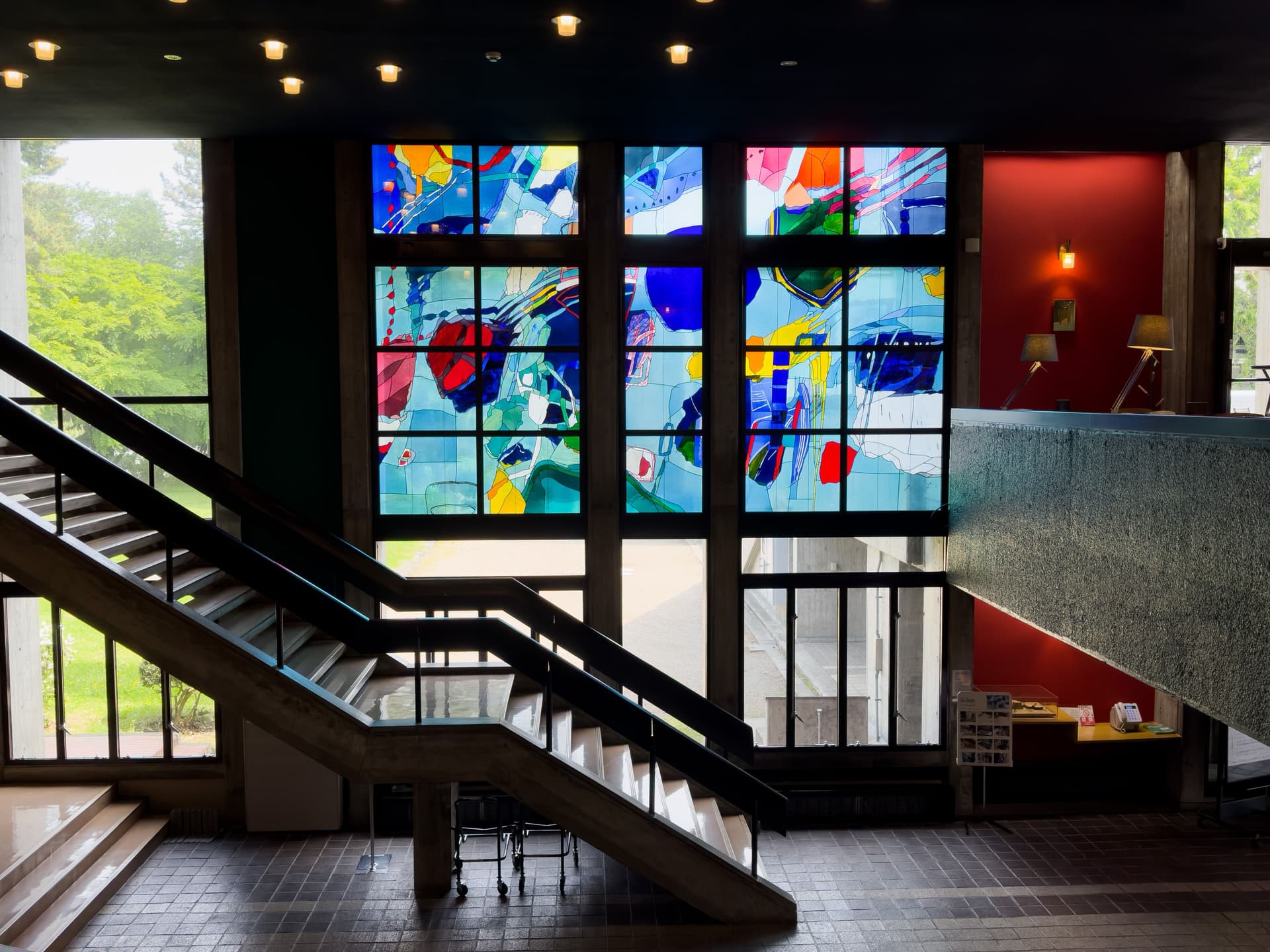
— This shop almost seems to float in a dreamlike space on the mezzanine floor of the building, where light filters in through stained glass. When did you open?
The Hirosaki Civic Hall here was designed by Kunio Maekawa, the same architect who designed the Tokyo Bunka Kaikan in Ueno Park, Tokyo. Although it was completed in 1964, its original colors and specifications have apparently been altered many times over the years in line with government policies and changing trends. In 2013, ahead of the hall’s 50th anniversary and in light of both the building’s aging and its architectural value, a large-scale year‑long renovation project was carried out to restore the colors and atmosphere of the good old Showa‑era building as it was at the time of its design. During this renovation, there was a public call for proposals to establish a new dining hall inside the building, and after a competition we have been operating the “Kissashitsu baton” café here since 2014. The stained glass is a work titled “Blue Time,” specially created for the 50th anniversary of the hall by Western‑style painter Nui Sano.
— Is the name of the café, “Kissashitsu baton,” derived from something related to architecture?
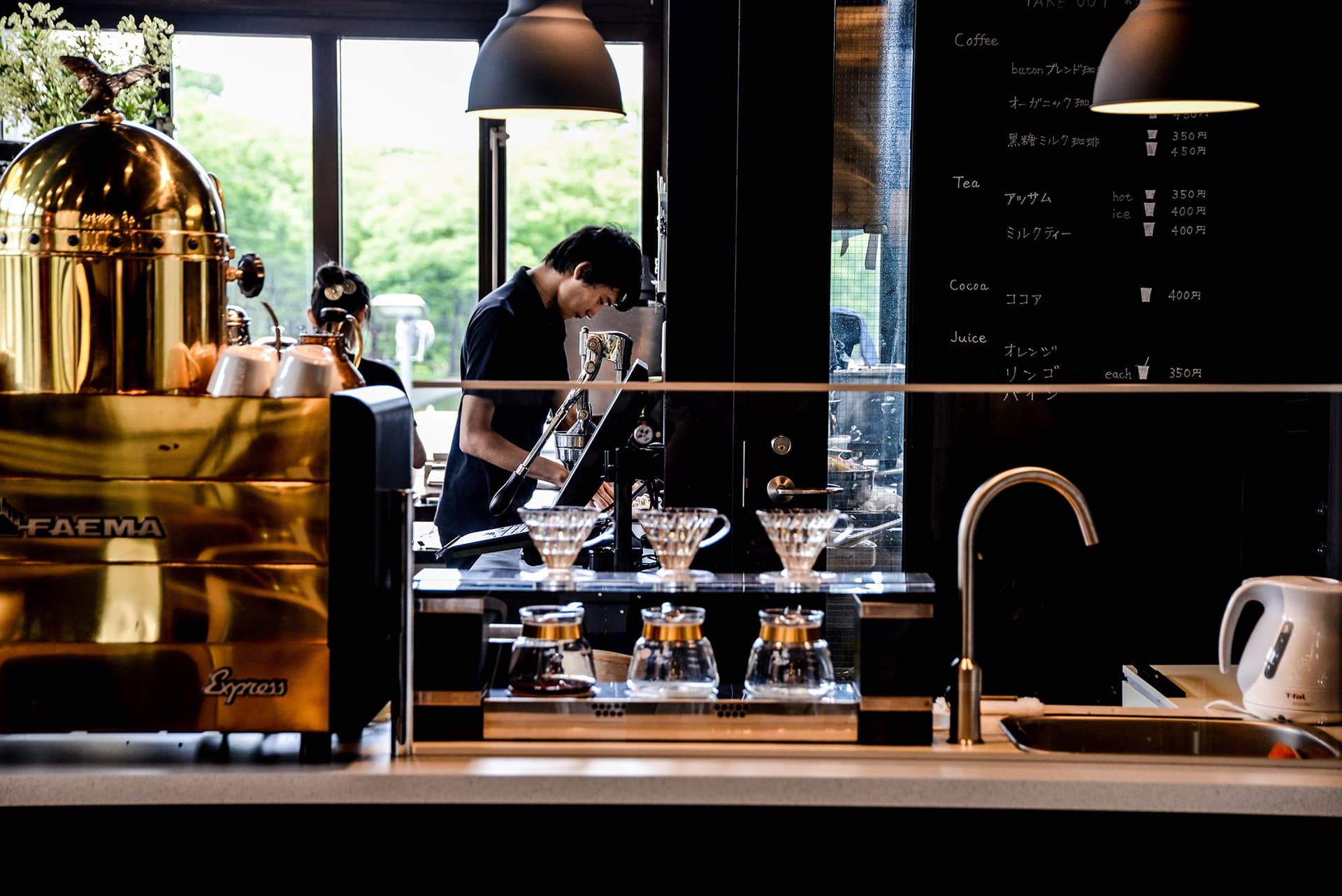
The name of the café, “baton,” was inspired by a device used in concert halls called a baton. A baton is a pole from which backdrops and lights are suspended above the stage. It’s something the audience cannot see, yet it is indispensable for completing the stage. The tearoom is intended as a place where visitors can savor the excitement and lingering impressions of the music and performing arts they experience in the building. We chose the name “Tearoom baton” to symbolize this essential element of a concert hall. The interior is modeled after Showa-era restaurants and cafés so as not to disturb the atmosphere and appearance of the time, in line with the intentions of the architect Kunio Maekawa, evoking what might be called a Showa-modern style.
— What kind of customers do you have?
Our customers range from their 30s to around their 70s, and the vast majority are women. Our business hours are from 11:00 to 17:00, so it seems many guests enjoy a meal or coffee here before going to concerts or stage performances. Since the hall is located inside Hirosaki Park, the period from around March to November is our busy season, with many tourists also making use of our services.
— Do you have any popular menu items?
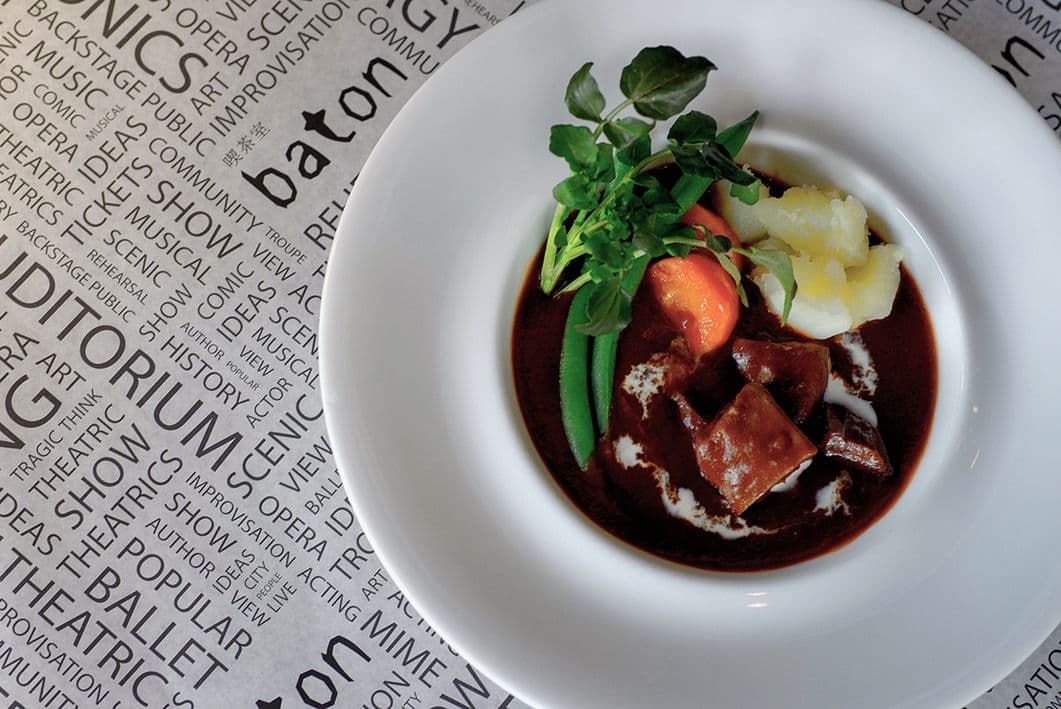
Our menu is based on a concept that recreates the Showa era, and dishes like Napolitan spaghetti and beef stew have been popular ever since we first opened. Pancakes served with fruits such as apples from Aomori Prefecture, as well as our five-colored jelly punch inspired by the lobby’s stained glass piece “Blue Time,” are also frequently featured on Instagram and other social media.

This popular restaurant quickly fills up the reservation slots set at 30% of its total capacity.
— What percentage of your customers make a reservation before coming to the store?
We have our own internal rules, and we’ve decided to limit reservations to about 30% of our 32 seats at most. Thanks to this, our reservation slots are fully booked every day. For online reservations, we only use AutoReserve’s system, and I think online and phone reservations are about half and half.
— Please tell us why you have set the maximum number of reservation slots to around 30%.
On weekends and during the busy season from March to November, we are visited not only by many local customers but also by many tourists, so we keep about 70% of our seats unreserved for walk-in guests. During peak periods, there is already a line at the entrance when we open at 11 a.m., and in cherry blossom season it’s not unusual for the wait to be two hours from the moment we open. People from Tokyo might not be surprised by that, but in regional areas we’re not used to waiting more than 60 minutes, so it can be tough. We hand out numbered tickets so that customers can go explore the castle in the park while they wait, and when it’s their turn, we call them on the phone.
— Was there any particular reason that led you to introduce the Respo reservation ledger?
We first learned about AutoReserve when our restaurant received a reservation request by phone. We run the restaurant with a total of 10 staff between the kitchen and the floor, but half of them are assigned to the kitchen, and at least one person has to be at the entrance to guide customers. Although we were receiving many reservation requests from AutoReserve, we were so busy with day-to-day operations that handling phone calls felt burdensome, so we decided to reach out to them ourselves. The representative kindly explained the system to us, and we became interested in the Respo reservation ledger, which has no monthly fee, allows us to manage reservations via an app, and even lets us collect cancellation fees. We felt this was something we really ought to implement.
Centralizing information reduces operational workload
— How have you been managing the reservation ledger up until now?
We had been managing reservations on paper ever since we first opened. The advantage of paper is that there is always a record left behind, and you can trace the history of when and how changes were made. At first, I thought that in that respect analog methods were superior, but after actually starting to use Autoreserve’s reservation ledger, I feel there’s almost no difference.
— Up until now, how have you been sharing information within the company?
We used to share information about changes using a paper reservation ledger and a LINE group. In the food and beverage industry we work in shifts, so staff members have different working hours, which makes it difficult to hold meetings with everyone present. When late-shift staff come in, it’s often during the peak busy time, so it’s hard to share information verbally. We still use the LINE group as a contact network, but after introducing the reservation ledger, it has become routine for staff to open the iPad and check the latest information. When there is a change to an online reservation, a notification email is sent to the registered account, so that can be shared among the staff, and because the reservation status for up to a month ahead is easy to see, it seems our operations have become more efficient. Phone reservations can also be centralized in the Respo reservation ledger, so I think this has reduced the operational burden.
From here on, during the busy season, we get a lot more phone reservations, and it’s not uncommon that we have to turn people away because all the slots are full. We’ve put a link to AutoReserve on our shop’s Instagram. If the share of online reservations increases, it will really help us with running the business, so we’re hopeful.
―――How do you feel about the support system?
―――How do you feel about the support system?
So far I haven’t had any issues, so I’ve been using it without ever needing to contact support. I’ve heard that with other companies’ services, updates have been neglected for a long time, but with AutoReserve, they always notify us in advance when there are specification changes and the like, so I haven’t felt any stress at all. I almost feel bad that I’m able to use it for free.
A chance to discern what should remain unchanged and what needs to change
— Could you tell us about your future prospects?
This is more of a management topic, but with the recent surge in prices, it’s expected that the cost of virtually everything will eventually rise. However, I feel that our selling prices are not keeping up with this inflation. Since the end of the COVID period, our sales have increased due to price hikes driven by higher costs, but our profit margins have shrunk. Our shop is also planning to revise prices in March and make major changes to the menu structure, and I believe we first need to make sure that this initiative is a success.
As for the new menu items, I think we’ll have to see how things go for a while and watch whether they gain our customers’ support. Our signature dishes, the Neapolitan pasta and the beef stew, have also been repeatedly refined over time by observing customers’ reactions and experimenting with plating and serving methods. It took three years to arrive at the current seasoning. Anything that’s still on the menu after three years is something we can confidently call one of our staples. It really does take time for a dish to go from development to being served, then be improved based on customer feedback until it finally settles into a stable form.
—After the period of rising prices and the COVID-19 pandemic, how have customers been responding?
We have many repeat customers, and so far we haven’t had any negative reactions, so I believe the extent of the price increase has been accepted. Since prices have gone up, we must ensure that the quality of the food improves accordingly.
I believe many restaurants in the greater Tokyo area have already started doing this, but we will inevitably have to raise our prices. And our customers will need to get used to that as well. To continue aiming for stable management, we must properly secure profits and focus on reaching customers who are satisfied with the new prices and services. You could say this is also becoming an era in which customers themselves are more clearly segmented.
—From here on, do you think the way businesses are run will change?
That’s right. Up until now we’ve been able to secure solid profits, so we could keep introducing various services and move our store management forward. For example, introducing a system incurs usage fees. If turning people-based services into systems would lead to better quality and more efficient operations, I was willing to actively spend money to bring in new tools. However, with rising prices, expenses are going up in step with inflation. When you convert the costs related to these systems, they end up becoming a drag on our expenses. As a result, we’re now in a situation where we have no choice but to review unnecessary systems and even touch the cost of ingredients for our menu. I feel we’ve reached a point where we need to break down and reconsider the components of our expenses.
Return profits through base pay increases and create a virtuous cycle
— What kinds of initiatives are you taking to review expenses and keep production costs down?
Up until now, in order to reduce costs such as labor and time, we had been placing orders with manufacturers to make things like sauces in bulk for us, but we’re now thinking of bringing those outsourced items back in-house. It’s really a return to our roots, isn’t it?
While we develop new menu items ourselves, we’re also creating the products we serve. It takes time, but each staff member’s skills improve, and if that all comes together, I believe it will give us much more range and strength in how we run the business. That said, we won’t bend the shop’s concept: we’ll keep the classic style of the good old Showa era, and our commitment to offering a menu that customers will support—so they can enjoy the time and space here—remains unchanged. It does take time and effort, but we’re excited to see how good we can make things, and I feel that this process itself is part of the shop’s change and growth.
― Are you viewing this opportunity as a positive turning point?
If we take this negatively, things will only get darker and darker, so all we can do is use this opportunity to work on moving in a better direction. I’m always thinking about what direction will truly delight our customers so that we don’t cause them any inconvenience, but right now we’re still in a trial-and-error phase. A year from now, if we’re properly turning a profit, maybe we’ll finally be able to feel reassured that the path we chose wasn’t wrong.
We will return our profits to the staff. In an era where it is difficult to secure and develop people, I believe that sales should be used less as company profit and more to raise base salaries as personnel costs. It’s important that people can feel proud of their work and find it meaningful. We have to make sure that at the end of the day they can feel, “I’m glad I worked today,” and that their service is properly rewarded. It may sound idealistic, but I believe it is the responsibility of management to create a system in which the people on the front lines of the service industry can keep doing their best and make a living.
Store Information
Tea Room baton
Address: 2F, Hirosaki Civic Hall, 1-6 Shimoshirogane-cho, Hirosaki City, Aomori Prefecture
Phone number: 0172-88-8928
Store details:https://autoreserve.com/restaurants/pQ3LBgrgqZgG8yQ1dNHT
Phone number: 0172-88-8928
Store details:https://autoreserve.com/restaurants/pQ3LBgrgqZgG8yQ1dNHT